
Executive Coaching for Senior Leaders: What L&D Often Sees Before Anyone Else
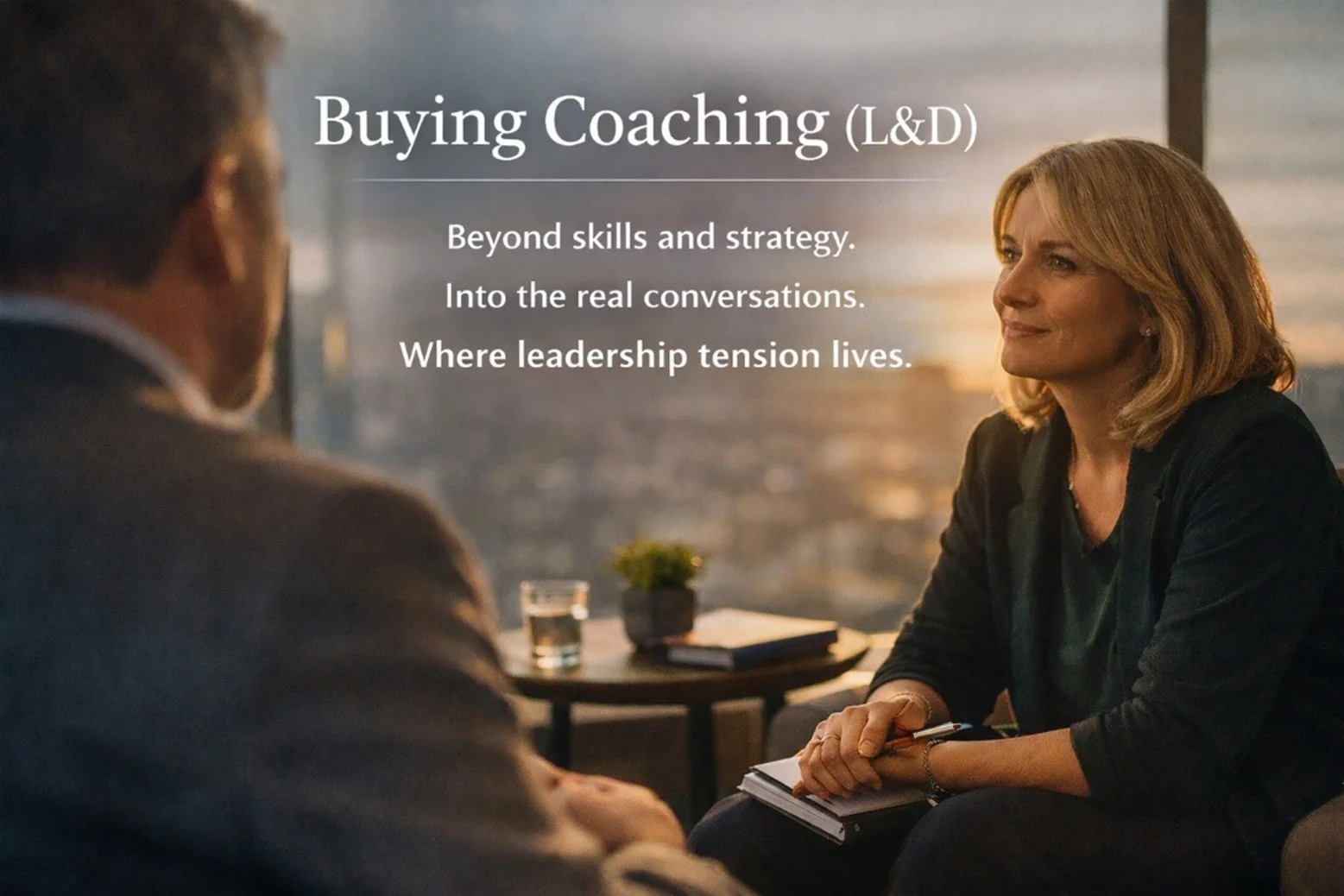
After more than 100 executive coaching assignments across financial services, professional services, publishing and the charity sector, one pattern has become clear:
The most significant leadership challenges rarely show up in a competency framework.
They show up:
In the pause before a difficult board conversation
In the tension between senior colleagues who “respect” each other but don’t trust each other
In the newly promoted director who suddenly feels exposed
In the high performer who quietly burns out while appearing composed
If you work in L&D or Talent, you recognise this.
You may not always be able to name it. But you feel it.
The Leadership Pressure Curve (Why Capability Isn’t the Issue)
Most organisations don’t struggle because their leaders lack intelligence.
They struggle because leadership becomes heavier as you rise.
More ambiguity
More visibility
More consequence
Less honest feedback
At the senior level, leaders often begin operating from pressure rather than presence.
The shift is subtle — but expensive.
Meetings become sharper
Listening reduces
Defensiveness creeps in
Avoidance increases
Teams feel it before anyone names it
By the time L&D is asked to “do something”, the pattern is often embedded.
What Executive Coaching Actually Develops (When Done Properly)
Executive coaching is not about polishing strengths.
It’s about expanding leadership capacity.
Capacity to:
Sit in discomfort without reacting
Have the conversation that’s been postponed
Hold complexity without oversimplifying
Separate ego from decision-making
Influence without control
Stay steady when the room isn’t
This level of development does not happen in a workshop.
It happens in sustained, psychologically safe — and appropriately challenging — dialogue.
What L&D Leaders Quietly Worry About
When I speak to Heads of L&D in regulated and high-performance environments, I often hear:
“We have strong leaders. But something’s missing.”
“They’re capable. But they struggle relationally.”
“We promote excellent performers — and then they stall.”
Underneath that are broader organisational risks:
Succession fragility
Cultural drift
Senior team tension
Political undercurrents
Leadership-level attrition
When coaching is contracted properly — with stakeholder alignment and systemic awareness — it doesn’t just support the individual.
It mitigates those risks.
Coaching Shapes Culture (Even When It’s Invisible)
Every external coach you bring into your organisation reinforces something.
They reinforce:
What accountability looks like
Whether the challenge is welcomed or softened
Whether ownership is taken or externalised
Whether vulnerability is a strength or weakness
Because coaching happens behind closed doors, its cultural impact is often underestimated.
But it is never neutral.
A Consistent Pattern I’ve Observed
Across mid to senior-level managers, and SLT/SMG level leaders, one thing is consistent:
When self-awareness and emotional regulation increase, the ripple effect is disproportionate.
Team dynamics shift
Escalations reduce
Clarity improves
Stakeholders lean in rather than pull away
It is rarely dramatic.
But it compounds.
And L&D feels the difference.
If I Were Leading L&D
In a regulated, high-accountability environment, I would want coaching that:
Understands commercial and regulatory pressure
Works systemically, not just individually
Is rigorous in three-way contracting
Is comfortable challenging senior leaders
Does not create dependency
Feeds learning back into the wider leadership strategy
Coaching should not sit as a perk.
It should strengthen succession pipelines, reduce behavioural risk, and increase leadership coherence.
Final Reflection
The organisations that will thrive over the next decade will not simply have capable leaders.
They will have leaders who:
Stay grounded under pressure
Regulate themselves before regulating others
Hold tension without transmitting it
That level of leadership does not develop through content alone.
It develops in conversation.
If you are reviewing your coaching panel, strengthening succession, or looking to deepen leadership capacity in a meaningful way, I am always open to a thoughtful discussion.
Because L&D is not just delivering programmes.
You are shaping the behavioural and emotional tone of the organisation.
And that work deserves depth.